Golden-cheeked Warbler Protocol Surveys
Presence/absence surveys for the golden-cheeked warbler, done to the U.S. Fish and Wildlife Service protocol under my federal recovery permit.
Permitted wildlife biologist · Central Texas
- USFWS golden-cheeked warbler recovery permit (ESPER32178096-0)
- Golden-cheeked warbler research with the University of Illinois
- Nine years at a national environmental consulting firm
When do you need a protocol survey?
Usually when your property has potential warbler habitat and something about your project calls for documented results, such as:
- Federal involvement. A federal permit or federal funding, such as a U.S. Army Corps of Engineers permit or a federally funded road, can bring U.S. Fish and Wildlife Service review.
- A habitat assessment found potential habitat and you need to know whether warblers are actually using it.
- A conservation plan or permit application asks for occupancy data, for example a habitat conservation plan.
- A lender, buyer, or contract requires wildlife due diligence before a sale or construction.
- You want a documented record before clearing, especially while federal rules are changing.
Not sure yet?
Most people don’t know whether they need a survey, and many don’t. Start with a free 15-minute call or the $395 desktop review. If there’s no potential habitat, you won’t need a survey at all.
Planning timing matters: surveys can only happen in spring, so checking early keeps your options open. What the 2026 federal rule changes mean →
What the USFWS protocol requires
These are the U.S. Fish and Wildlife Service minimums (July 2025). They’re why a protocol survey takes a whole spring.
- Survey season
- March 15 to June 1 only, with at least 60 percent of visits before May 15
- Number of visits
- At least 5 visits, no more than 1 visit in any 5-day period
- Time of day
- Starting no earlier than 30 minutes before sunrise and finishing within 7 hours of sunrise
- Survey effort
- At least 1 hour per 25 acres of potential habitat per visit, and never less than 1 hour per visit
- Weather
- No surveys in wind over 12 mph, fog, rain, or temperatures below 45°F or above 80°F
- Playback
- Recorded calls are used to confirm absence only after 5 visits with no detections, and stopped immediately if a warbler responds
- Reporting
- Survey data goes to USFWS under my permit by June 30 of the survey year
What you should know before you start
One year may not be enough
In most cases, USFWS requires at least 3 years of negative results to conclude that warblers are absent from a property. A single spring with no detections is a strong data point, but it doesn’t prove absence on its own.
A negative result also applies only to that survey year and doesn’t authorize development.
Results go to USFWS
Because I survey under a federal permit, the survey data is reported to the U.S. Fish and Wildlife Service each year. That’s a condition of the permit, and I’ll walk you through it before we start.
If warblers are found, I’ll explain your options, such as adjusting your plans, a regional conservation plan, or working with USFWS.
Weather sets the schedule
Wind, fog, rain, and heat all stop a survey. Visits are scheduled around the forecast within the spring window, which is another reason to book early.
Access matters
I need reliable early-morning access for every visit. Survey areas can include adjacent areas where access allows, and access limits can affect the scope.
Texas servicesIs your property in golden-cheeked warbler country?Preview the county guideClose the preview
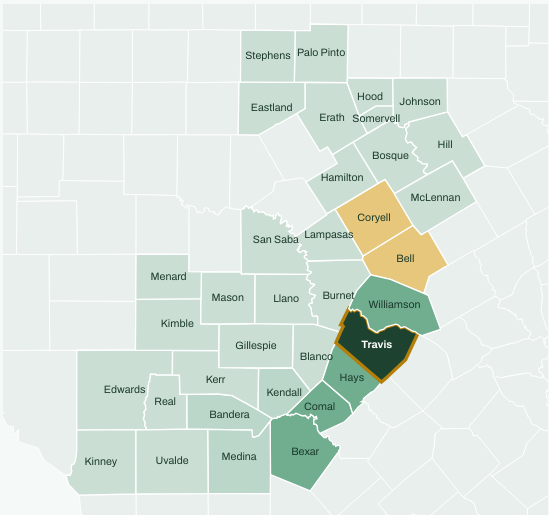
Is your property in golden-cheeked warbler country?
Habitat assessments and protocol surveys are for Texas properties. Pick your county to see its warbler planning programs, maps, and contacts.
Open the county guideHow your quote is built
I bill $135 per hour for the actual time, including drive time for every visit. Before the season starts, you get a written estimate with a maximum.
| Task | What it covers | Typical hours |
|---|---|---|
| Scheduling and site access | Access, gates, and landowner contacts for the season | 1–2 |
| Drive time | Round trip from Austin (Travis County), for each of at least 5 visits | Actual time |
| Field surveys | At least 5 visits; about 1 hour per 25 acres of potential habitat per visit | 5+ (varies by acreage) |
| ArcGIS mapping and data | Survey area and observation maps, plus the USFWS data | 2–4 |
| Survey report | Methods, results, maps, and what they mean for your project | 3–6 |
| USFWS reporting | Submitting survey data under my permit | 1 |
| Mileage | From Austin, for each visit | IRS standard rate |
| Lodging and meals | Only for properties more than 50 miles from Austin | Federal (GSA) per diem |
| Desktop review credit | Your $395 desktop review, if you started there | −$395 |
Example: 50 acres of potential habitat, 40 miles from Austin, one spring season is about 26 to 34 hours, roughly $3,495 to $4,575, plus about 400 miles at the IRS mileage rate. Your written estimate is based on your property. Try the estimator
Common questions
Can the survey be done in one visit?
No. The protocol requires at least 5 visits during the spring window, spaced at least 5 days apart.
What if we miss the spring window?
Surveys can only happen March 15 to June 1. If you miss it, the next chance is the following spring, so plan early. A desktop review or habitat assessment can be done any time of year.
Do I really need three years?
To show that warblers are absent from a property, USFWS usually expects 3 years of negative results. Whether you need all three depends on your project and what you’re using the results for. I’ll help you decide.
Does a survey give me permission to clear?
No. A survey documents what was found. It doesn’t authorize development, and my recovery permit doesn’t cover a project’s impacts.
Spring fills up fast.
Book a free 15-minute call to plan your survey season.